
SAGE X3
- Enseignant: Trannois Magali

- Enseignant: Leclerc Willy
- Enseignant: Swida-Lancelin Amelia
- Enseignant: Swida-Lancelin Amelia
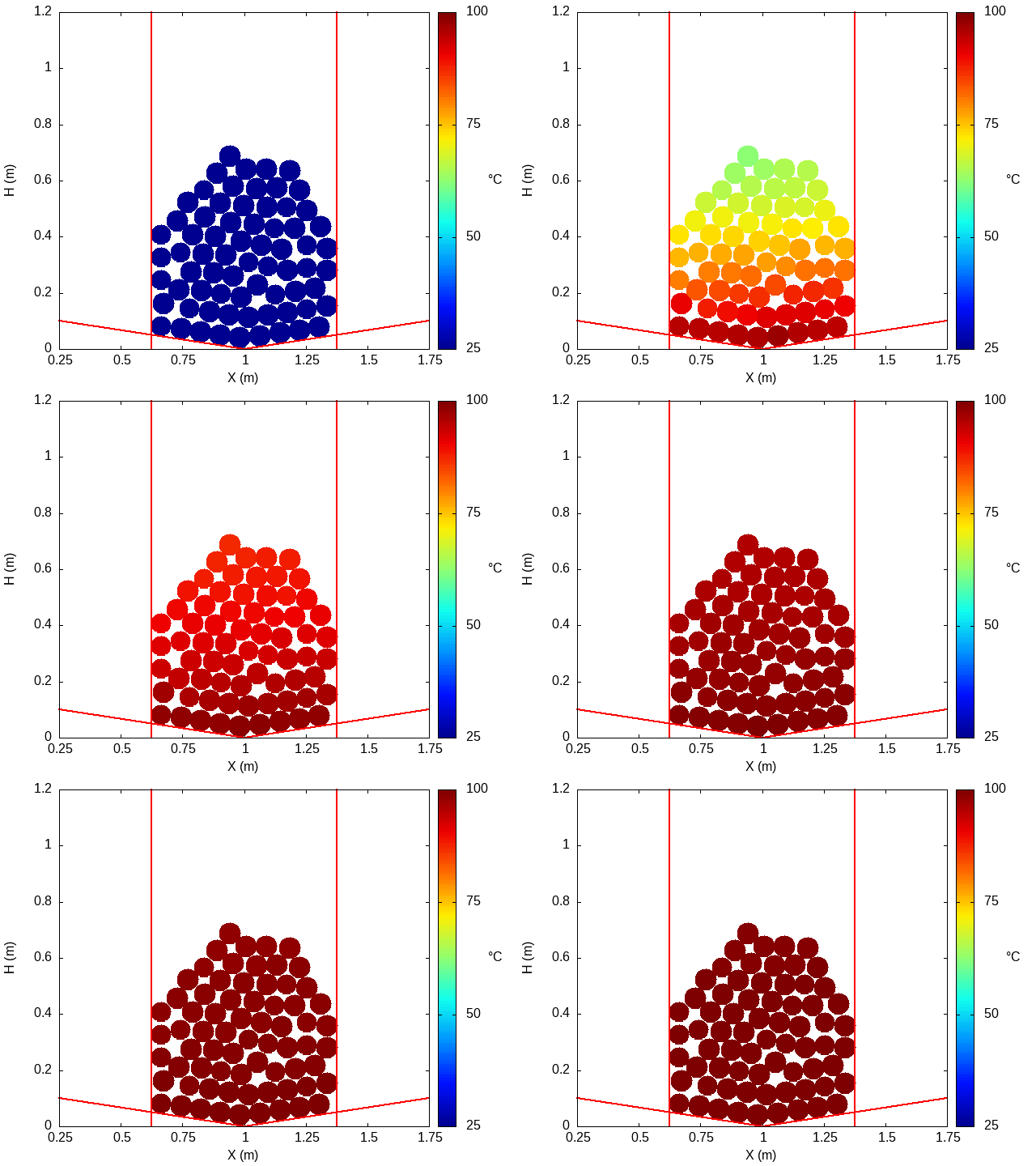
Utilisation du langage de programmation C++ pour la conception d’algorithmes de simulation numérique basés sur la Méthode des Éléments Discrets. Application à la modélisation du comportement dynamique des systèmes multi-contacts (milieux granulaires) et phénomènes de transfert (transfert thermique par conduction et conductance).
- Enseignant: Guessasma Mohammed
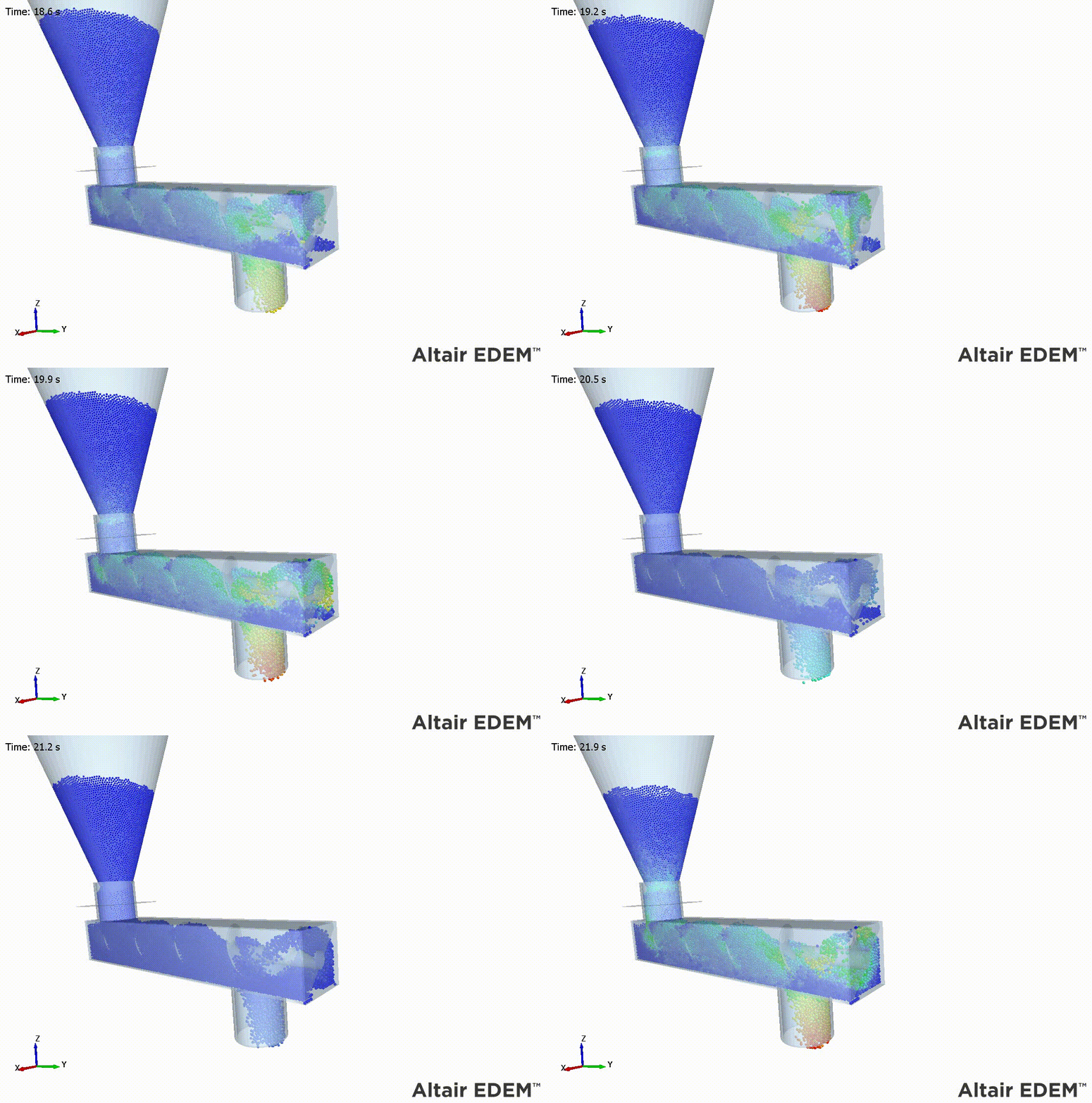
Modélisation et simulation des écoulements granulaires avec le logiciel Altair EDEM:
- Remplissage et vidange des silos : étude de influence de la géométrie de la trémie sur la composition du produit vidangé.
- Convoyeur à vis : étude de l'influence du pas de la vis d'Archimède lors du transport d'un produit en vrac.
- Déposition d'un lit de poudre : étude paramétrique de l'influence de la vitesse de l'inclinaison du racleur lors du procédé de FA sur lit de poudre.
- Enseignant: Guessasma Mohammed
This class enables students to know the basics of exporting.
Exporting has become an important component in company strategy: the fact that markets may stagnate, international competition, the world being shared between those who have the knowledge, those who have low-cost manpower, and those who have the purchasing power, the search for profitability are all pushing companies to hunt for other markets abroad.
Import management in the same way includes however an increased responsibility to ensure supply chain resilience.
- Enseignant: Gauthier Frederic
- Enseignant: Gauthier Frederic
This course provides students with an overview of transport and logistics issues in a global economy. Historical background and spatial dimension are associated with concrete methods of network analysis and case studies of terminals, gateways, hubs, and corridors where issues of cost, accessibility, performance, and congestion are analyzed.
At the end of the course participants will be able to:
Assess the role of transport and logistics activities in
local and global economic development
Distinguish key success factors in the elaboration of
transport and logistics projects
Measure and compare the performance and vulnerability of
transport and logistics nodes based on rigorous indicators
- Enseignant: Gauthier Frederic
Objectives
Identify or define :
The set of decisions that operations managers make, The trends and challenges facing operations management, The customer-supplier relationships between processes,
To understand the escalating importance of international logistics as competitiveness becomes increasingly dependent on cost efficiency,
To learn about materials management and physical distribution, both part of international logistics ;
To learn why international logistics is more complex than domestic logistics ;
To see how the transportation infrastructure in host countries often dictates the options open to the international manager ;
To learn why inventory management is crucial for international success ;
To assess distribution performance through inventory management policy ,
To learn using indicators for that purpose,
To learn how to use main distribution policy available for a company worldwide, a global company, small to medium size and large company ;
To identify main distribution channels worldwide and the way to weigh them
Describe or explain : Operations in terms of inputs, processes, outputs, information flows, suppliers and customers, the importance of taking a process view to operations in a firm, Operations as a function alongside finance, accounting, marketing, management information systems, and human resources; how operations can be used as a competitive weapon
Method
To alter conferences and case studies
To have two main guides through powerpoint presentation and case studies
Evaluation
Evaluation of three case studies during the course
Final examination
References
Ballou, Business Logistics Management, Englewood Cliffs N.J. Prentice-Hall
McConville Shipping Business and maritime Economics : an annotated international bibliography , London, Mansell
Wood ed. International logistics New York, Chapman & Hall
International Business, The Dryden press, Harcourt Brace College Publishers
Global Operations and Logistics, Michel Fender, John Wiley & Sons
- Enseignant: Gauthier Frederic